What a Revenue Headline Leaves Out
Working through Ro’s $3 billion run-rate claim, GLP-1 economics, and what Robin might mean for its membership business.
Disclosure. I used to work at Ro and was part of the June 2022 layoffs. I hold no Ro equity. I respect what the team has built, and everything I discuss here comes from public sources. I don’t have access to Ro’s current financials. Nothing here is intended to disparage Ro or the people who work there. This is my good-faith attempt to understand the business and its public claims; the opinions and illustrative assumptions are my own.
I’ve worked at a number of startups, and over the past few years at Bloomberg I’ve gotten a lot more interested in markets. Watching the AI mania has made me more skeptical of how startups talk about themselves. When a company puts out a big announcement now, I find myself asking why it picked that particular number, why it chose those words, and who it actually wants reading the post.
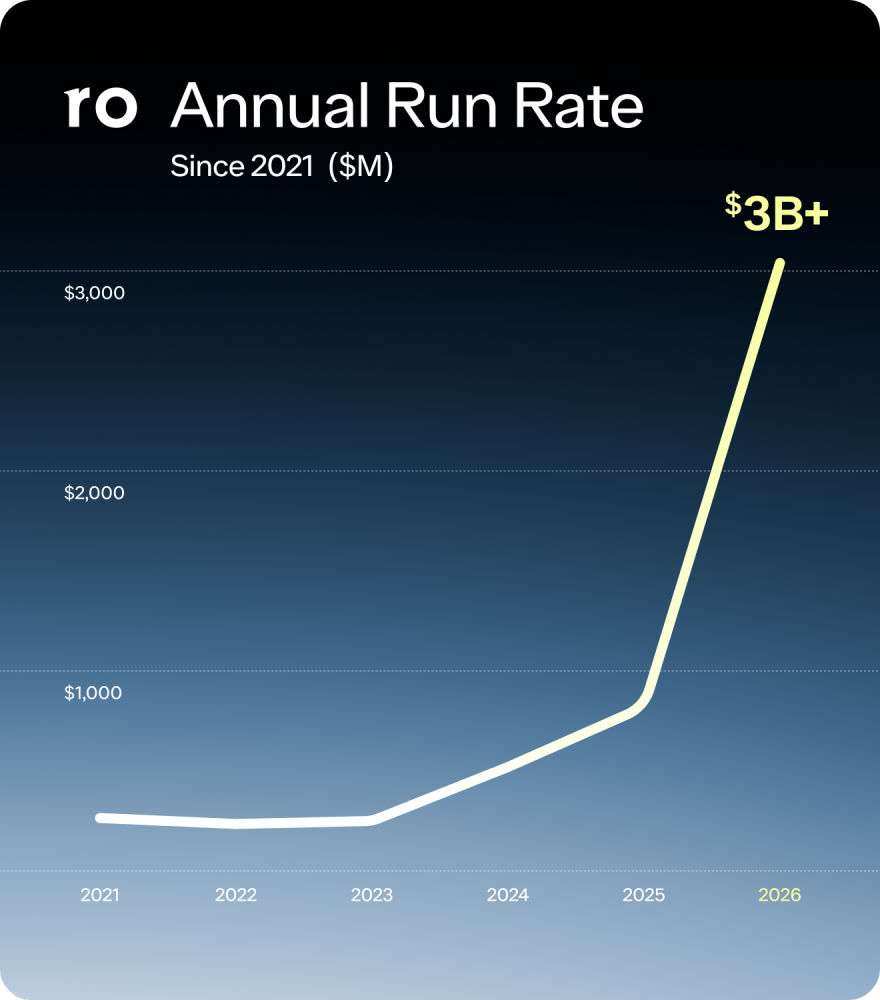
When I joined Ro, it was a hot startup. It was only a few years old, I kept seeing Roman ads, and the company had a popular men’s health product. In his November essay, Ro co-founder and CEO Zachariah Reitano, who goes by Z, looked back on a company growing about 9% a year at a $270 million run rate at the end of 2021. He called it a “zombie.” His chart defines ARR as November revenue multiplied by 12.
Source: Reitano’s November essay
I agree with Z that Ro was a zombie. Where I disagree is with how much weight he puts on culture when he tells the story of the layoffs. On Invest Like the Best, he talks about rebuilding the culture, and in his essay he says Ro parted ways with talented people who didn’t fit. That may have been true for some people. He also acknowledges that Ro hired too many people. At the time, management told employees the cuts were about managing expenses and putting resources behind the company’s strategy. That’s closer to how I think about why the layoffs happened.
Sources: Podcast · Reitano’s essay · TechCrunch’s June 2022 reporting
By the time Ro cut jobs in June 2022, the Fed had started raising rates from near zero. Ro had bought Modern Fertility in May 2021 for a reported $225 million or more, mostly in stock. It bought Dadi in early 2022 for a reported $100 million. I couldn’t verify how much of the Dadi deal was cash or stock. Ro had made two big bets on fertility just as the era of cheap money was coming to an end.
Sources: Federal Reserve rate history · Modern Fertility deal · Dadi deal
I don’t know how either business has performed. From the outside, I see Ro put a lot more marketing behind weight loss and men’s health than fertility. Ro says it’s discontinuing the Modern Fertility Hormone Test, and the Ro Sperm Kit page directs past customers to log in. That makes me wonder whether either acquisition has justified its price tag.
Sources: Modern Fertility Hormone Test · Ro Sperm Kit
After a round of layoffs and a series of hard decisions about what to keep building, management did what Z calls “refounding” the company in 2022. I’m still a little unsure what makes that a refounding. Ro cut products and narrowed its focus, and the basic business of providing care online carried on. Four years later, Ro says it has crossed a $3 billion run rate. That’s an impressive number.
I take the milestone at face value. What I keep coming back to is the decision to announce it this way. Why annualize November revenue in a post that went up on November 11? Why compare Ro with companies like Anthropic and OpenAI? And who is that comparison for? I had those questions in mind when I went back to the October 29 announcement of Robin, Ro’s AI health agent. Read together, the two announcements made me wonder what kind of business Ro wants people to see when they look at that $3 billion figure.
Source: Business Insider’s coverage of Robin
What the revenue headline measures
Alongside the $3 billion figure, Reitano reports that Ro’s revenue grew at a compound annual rate of more than 100% over the past three years.
The distinction between the essay’s use of ARR and its title matters here. Annualizing November revenue gives Ro a run rate based on one month.
Annualizing a month can describe a business’s current scale. It does not establish what the company earned over the preceding year, how much revenue will recur, or how much gross profit that revenue produces.
There is also a timing question. The post appeared on November 11, before November was complete. Is the current-year number based on projected full-month revenue, an extrapolation from activity so far, or another convention? That deserves an explanation. A founding anniversary would not establish the company’s fiscal calendar or answer that question.
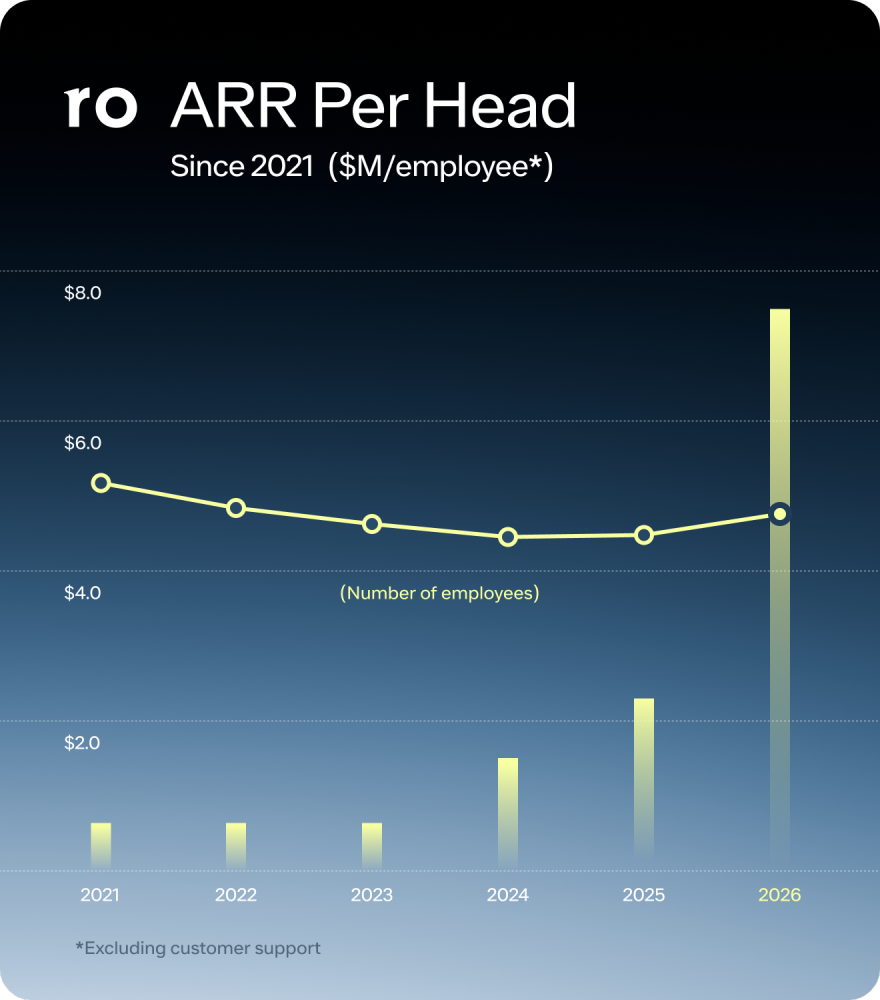
What is included as revenue
To Z’s credit, he acknowledges how much the GLP-1 wave helped Ro. And Ro is still riding it. The shortage may be over, but demand is still growing. Lilly says U.S. Zepbound sales rose 48% year over year in the third quarter of 2026, driven primarily by demand. What changed for Ro along the way was how it could get these drugs to patients, and what patients had to pay to get them.
Sources: Reitano’s essay · Lilly’s third-quarter results
I was let go before Ro Body launched in January 2023. Ro Body was a monthly membership for online weight-loss care. The idea was that you could go to Ro, meet a clinician by video, get lab work, and get a prescription for a GLP-1 if the clinician thought it was appropriate. Ro also sent you a connected scale and offered ongoing nurse coaching and follow-ups. If you wanted to use insurance for the medication, Ro would help figure out what your plan covered and handle the paperwork.
Sources: Ro Body launch · Ro’s explanation of insurance coverage
The part I always wondered about was what your insurance would actually pay once you went through the program. A Ro clinician could write the prescription and Ro could help request prior authorization, but your insurer still decided whether to cover the drug. Some plans excluded weight-loss medication altogether, and even when a plan covered it, you might need approval first. By 2024, reporting put the ongoing membership fee at $145 a month, with the drug billed separately. Ro lists Ozempic at roughly $900 to $1,100 without coverage, so a patient paying cash could be looking at close to $1,200 a month all in. That’s a big difference from paying the membership fee plus an insurance copay.
Sources: 2024 coverage · Ro’s insurance and pricing details · Ro’s Ozempic pricing
Even if you had a prescription and knew how you were going to pay, your pharmacy had to have your dose in stock. Demand for the injections was running ahead of what manufacturers could supply. The FDA listed Wegovy injections, Novo Nordisk’s semaglutide for weight loss, in shortage in March 2022. It added Ozempic, Novo’s semaglutide for type 2 diabetes, that August. So the semaglutide shortage was already underway when Ro Body launched. Lilly’s Zepbound, which uses a different drug called tirzepatide, was affected by a separate shortage. I take Zepbound, and I remember how hard it was to find.
Sources: FDA’s semaglutide shortage review · FDA’s tirzepatide shortage review
That supply problem gave Ro another way to serve patients. While injectable semaglutide was on the FDA’s shortage list, qualifying compounding pharmacies could supply versions of it under rules that applied during shortages. By early 2024, Ro was offering compounded semaglutide as a backup for patients who couldn’t find the brand-name drug. Hims started offering it that May. I wouldn’t be surprised if being able to fill a prescription when patients were struggling to find the branded drug drove a big jump in revenue for Ro. I’d like to know how much of that business carried over once the branded drugs were easier to get.
Sources: FDA compounding timeline · Business Insider’s May 2024 reporting
The FDA declared the injectable semaglutide shortage resolved in February 2025 and gave compounders a transition period. For outsourcing facilities, the agency’s enforcement discretion for shortage-based copies ran through May 22. The transition was messy. Sherwood found that Ro’s intake still showed a compounded option one day in June and stopped showing it later that week. In September, the FDA sent Hims a warning letter over what it called misleading claims about the compounded semaglutide Hims was still offering. Ro’s current pricing page centers on branded drugs.
Sources: FDA compounding timeline · Sherwood’s June reporting · FDA warning letter to Hims · Ro’s current pricing
For cash-pay branded drugs, Ro now works with LillyDirect for Zepbound and NovoCare Pharmacy for Wegovy. On the LillyDirect cash-pay route through Gifthealth, a Ro-affiliated clinician can write the prescription and Gifthealth handles fulfillment and delivery. Ro’s terms say it can collect the payment on the LillyDirect partner pharmacy’s behalf, and that some prescriptions may be dispensed through Ro’s pharmacy network. Ro identified CenterWell Pharmacy as the dispensing and delivery partner when it announced the NovoCare integration.
Sources: Ro’s LillyDirect terms · Gifthealth fulfillment · Ro’s NovoCare announcement
That Gifthealth transaction looks like an agency arrangement from the outside. If Ro is the agent for the medication sale, it would generally recognize whatever fee it earns from arranging the sale. If Ro is the principal for a sale, it generally recognizes the full transaction price as revenue and accounts for the related costs separately. The distinction turns on who controls the product or service before it goes to the customer. I haven’t seen public terms that confirm whether Ro gets a referral fee from Lilly or disclose what it would be.
Source: FASB’s principal-versus-agent guidance
Anthropic, one of the companies Z compares Ro with, is a good example of why I care about what gets counted. Reuters reported that Anthropic counts the full value of sales through cloud marketplaces as revenue, including the portion it owes its cloud partners. Anthropic’s prospectus lists channel partner fees under sales, marketing, and partnerships expenses. So part of the revenue investors see at the top is already spoken for. When I look at Ro’s number, I want to know what it includes from membership fees, drug sales, and any fees Ro earns for arranging prescriptions.
Sources: Reuters on Anthropic’s reporting · Anthropic’s prospectus
The price I can verify is the membership. Ro lists $39 for the first month, then $149 month to month or as low as $74 a month if you prepay for a year. Medication costs extra. On Reddit, one patient said they canceled Ro after getting a year of insurance authorization and asked their OB-GYN to take over prescribing. Another said they used Ro to start Zepbound and canceled after finding a primary care doctor. Those are individual accounts, but they get at what I want to know about the membership. How many people keep paying for the care once they can fill the prescription through their own doctor and pharmacy?
Sources: Ro Body pricing · Insurance authorization account · Switching to primary care account
How Hims & Hers reports revenue
Hims & Hers is the public competitor I’d start with. It sells online care in many of the same categories as Ro, including weight loss, hair loss, and sexual health. The advantage of looking at Hims is that we can read its filings and see how it decides which part of a prescription transaction counts as revenue. LifeMD is another publicly traded competitor with a GLP-1 weight-management program.
Source: LifeMD annual report
In its third-quarter 2026 10-Q, Hims reports $890.4 million in revenue, split between $657.1 million in the U.S. and $233.3 million internationally. It says most U.S. revenue came from offerings other than GLP-1s. I don’t see a dollar breakdown in the filing for GLP-1s, weight-loss membership fees, or fees from arranging prescriptions. So the filing gets us closer to the answer, but it still doesn’t tell us what a dollar of GLP-1 spending turns into for Hims.
Source: Hims & Hers Q3 2026 10-Q
Where Hims does get specific is in the accounting notes. For certain prescriptions filled by outside pharmacies, Hims picks the pharmacy, directs fulfillment, and is responsible to the customer if something goes wrong. In those transactions it acts as the principal, so it records the sale price as revenue and records its costs separately. In other arrangements, the platform partner controls fulfillment and handles related refunds. There Hims acts as the agent, so it records only what it earns for arranging access. The same company can report two prescriptions differently depending on who controls the sale. That’s the detail I’d like Ro to spell out for its own pharmacy arrangements.
Source: Hims & Hers revenue recognition policy
You can also see what happened to Hims’s gross profit as sales grew. Compared with the same quarter a year earlier, revenue rose 49%, from $599 million to $890 million, while gross profit rose 15%, from $442 million to $509 million. Gross margin fell from 74% to 57%. Hims points to more frequent shipments and higher fulfillment costs in weight loss, alongside international growth, new offerings, and acquisitions. That’s the comparison I want to be able to make for Ro. As more patients pay for GLP-1s through the platform, how much additional gross profit does Ro earn, and how much comes from the membership versus the medication transaction?
Sources: Hims & Hers Q3 2026 results · Hims & Hers Q3 2026 10-Q
What Ro might earn from LillyDirect
Hims added about $291 million in quarterly revenue year over year and about $67 million in gross profit. That’s roughly 23 cents of additional gross profit for every dollar of additional revenue across the company. It gives me a sense of how differently those two numbers can move. To estimate what Ro might earn from LillyDirect, I still need to know how much patients spend through that channel and how Ro is compensated for arranging those sales.
Source: Hims & Hers Q3 2026 10-Q
In October 2021, Ro told TechCrunch that Roman, its men’s-health brand, accounted for about half of revenue. Applying that share to Z’s $270 million year-end run rate puts Roman at roughly $135 million. That’s a back-of-the-envelope number because the October revenue mix may have differed from November’s. To give the whole pre-GLP-1 business credit for growth, I’ll assume all $270 million grew 10% annually for five years. That puts Roman at about $217 million and the entire pre-GLP-1 business at about $435 million by 2026.
Sources: TechCrunch’s 2021 reporting · Reitano’s run-rate figures
Using $3 billion as the headline run rate leaves about $2.57 billion above my estimate for the old business. For this scenario, I’ll assume GLP-1 prescription sales account for 90% of that gap, or about $2.31 billion. I’ll then assume LillyDirect accounts for 70% of those prescription sales, or about $1.62 billion. That allocates about $693 million to other GLP-1 prescription sales and $257 million to memberships and other revenue in the gap. These are assumptions about the composition of the headline, including that it contains the full medication sales price. I haven’t found a public breakdown confirming that mix or accounting treatment.
Sources: Ro Body pricing · Ro’s LillyDirect terms
For an illustrative scenario, I’ll assume Ro earns a commission equal to 5–10% of LillyDirect medication spending through its platform. I chose that range to see how much the result changes with the fee. The public disclosures don’t establish either a percentage commission or a likely rate for Ro. The Senate report documents contract payments to Form Health, 9amHealth, and Cove, so it gives us evidence that Lilly pays some telehealth partners, while leaving Ro’s arrangement unresolved. Under this assumption, every $1 billion of annualized medication spending would generate $50–100 million in annualized fees.
Source: Senate report
Applying the assumed 5–10% commission to $1.62 billion of annualized LillyDirect medication sales gives Ro about $81–162 million in annualized fees. LillyDirect represents 63% of the original $2.57 billion gap in this scenario, because 90% multiplied by 70% is 63%.
Adding those fees to the $435 million modeled legacy business gives a subtotal of about $516–596 million annualized, before memberships and other GLP-1 revenue. To adjust the whole headline under this scenario, I would subtract the $1.62 billion of assumed gross LillyDirect sales from $3 billion and add back $81–162 million in fees. That puts the annualized total at about $1.46–1.55 billion, with the other GLP-1 sales and the remaining revenue kept at their modeled amounts. This adjustment depends on Ro counting LillyDirect sales gross in the original headline. If it already reports that channel net, the subtraction would understate revenue.
Even with only the possible fees, $81–162 million a year would be an impressive number for a business acting essentially as a prescription agent in those transactions. That estimate rests on heavy assumptions about the sales mix, the commission, and how Ro reports revenue. But if it were anywhere close, it would show how valuable it is to bring patients into the system and help them get a prescription filled. Ro also provides clinical care and ongoing support through its membership. The fee estimate covers just the assumed payment for arranging the medication sale.
Why announce it this way
This is why I wanted to work through the numbers. A business earning fees for arranging prescriptions, a company selling medication, and a subscription service providing ongoing care can all grow quickly. Each gives investors a different set of questions about margins, customer retention, and how much the business is worth. I want to understand which parts are driving Ro’s growth before comparing its $3 billion headline with the growth of an AI company.
My theory is that the announcement is partly aimed at the people who decide where venture capital goes. After watching the AI boom, I’ve become skeptical of how easily a company outside that category can get investors’ attention, even with a substantial business. Crunchbase estimates that AI companies took 64% of global venture funding in the third quarter of 2026. KPMG also describes a market increasingly concentrated in large AI rounds, with investors becoming more selective outside those areas. There is still funding for other businesses, but AI is taking a disproportionate share of the money and attention.
Sources: Crunchbase Q3 funding data · KPMG Q3 venture report
That is what makes the timing of Robin interesting to me. Ro announced its AI health agent in October, then followed in November with a $3 billion run-rate milestone and comparisons to companies including Anthropic and OpenAI. Together, those announcements give investors a story about a company that already has patients, revenue, and the infrastructure to deliver care, and can now use AI to expand what it does for those patients. The existing business gives the AI pitch something concrete behind it. The AI product gives investors another reason to imagine a much larger future business.
Sources: Robin launch coverage · Reitano’s November essay
I also wouldn’t be surprised if Ro is trying to “refound” itself again, this time by moving beyond the DTC prescription business. I struggle to see a durable moat in helping consumers buy medications they can get from competing services. Brand, convenience, and good care matter, but Ro doesn’t own the branded drugs. If another provider offers the same medication with a lower membership fee, or a patient’s regular doctor takes over the prescription, Ro needs to give that patient another reason to stay. A large volume of prescriptions can produce an impressive business while leaving that question unanswered.
AI companies face their own version of this pressure as competing models become capable of doing similar work. But the comparison with Anthropic has an important difference. Claude brings in revenue from businesses that can embed it into their own products and internal workflows. Its enterprise offering includes integrations, access controls, and audit logs. Once a company has approved a vendor, connected its systems, and built processes around it, changing providers can mean more security reviews, engineering work, testing, and employee training.
Sources: Anthropic’s enterprise offering · Anthropic’s enterprise customers
That is why I would expect those business relationships to be harder to displace than a consumer subscription. A company might add another model without removing Claude from everything it already uses it for. The models can face pressure to become interchangeable while the systems built around them make switching expensive. I’m not assuming enterprise customers stay forever, but there is a practical cost to leaving that a consumer comparing monthly prescription services may never face.
That gives me another way to think about Robin. If Ro can become the place a patient returns to for help understanding and managing their health, it could build a relationship that lasts beyond a particular prescription. A service that knows your history and helps coordinate your care could give you more reasons to keep paying for a membership. I can see why Ro would want that kind of business. Whether Robin actually creates that habit, and whether patients value it enough to stay, is what I would want to see next.
The less flattering way I see that pivot is from a GLP-1 wholesaler to a token wholesaler, or a business doing both. I’m using “wholesaler” as shorthand for packaging and selling access to something another company produces. If Robin relies on third-party models, Ro would be building a health service around intelligence it buys from someone else, alongside a medication business built around drugs it buys or helps patients access. The question becomes how much value Ro adds around those inputs, and how much of that value it can keep.
In my opinion, that could increase Ro’s risk. Its existing exposure to medication regulation would remain, and a dependence on outside models would add another supplier whose decisions could affect its economics. Higher model prices, changes in commercial terms, or patients using Robin more heavily could put pressure on the margin from a fixed membership fee. Even falling token prices could create pressure if competitors pass those savings on and patients start expecting similar AI features for less.
There is also the risk that the model provider competes with the product built on top of it. If that provider adds health records, personalization, or care-navigation features to its own consumer offering, it could absorb some of what makes Robin worth paying for. It wouldn’t need to replace Ro’s clinicians or prescription fulfillment to weaken the AI part of the membership pitch. Ro would have to build enough value in its care, integrations, and patient relationships to withstand that. That is why I’m not convinced adding AI automatically makes this a more defensible business. Depending on how Robin is built, Ro could end up exposed to both pharmaceutical suppliers and model providers.
I also wonder how much of Robin needs to be a separate product at all. Ro could probably deliver much of the same functionality through a plugin for ChatGPT or a connector for Claude, giving the assistant permissioned access to patient information and tools for interacting with Ro’s care team. Both platforms already support integrations with outside data and services. Ro would still have to build the clinical workflows, access controls, and safeguards, and an integration would not automatically reproduce every feature of Robin. But if patients could get much of that experience inside an assistant they already use, I would question how much of the moat belongs to Robin itself. The lasting value would have to come from the care and services Ro connects it to.
Sources: ChatGPT apps · Claude connectors
My suspicion is that these announcements serve both ambitions. They help Ro compete for capital in a market where investors are eager to fund AI, and they describe a broader business with the possibility of more lasting customer relationships. That could make a future fundraising round easier to sell and give investors another reason to value Ro’s existing patient base. That’s my interpretation of the announcements. Whether Ro is preparing a raise, and what role that played in the timing, remains an open question.
After all of this, I’m still not sure Z’s essay proves that Ro is no longer a “zombie” company, or whether it could still be one that brings in a lot more top-line revenue. The growth is impressive, but the growth story doesn’t quite add up for me. A GLP-1 wave and an AI product give Ro plenty to talk about. What I’m less clear on is how much of that revenue Ro keeps, why patients will stay, and what protects the business when its suppliers or competitors change the terms. Those are the questions I would need answered before I felt convinced that the refounding had solved the underlying problem.
This conclusion may be a “fork found in kitchen” moment for anyone who does this for a living. I’m new to this kind of business analysis, and I find it exciting to work through the numbers, question the story around them, and see what I can actually support. Even if some of the answers seem obvious to someone else, figuring them out for myself is part of the appeal.